
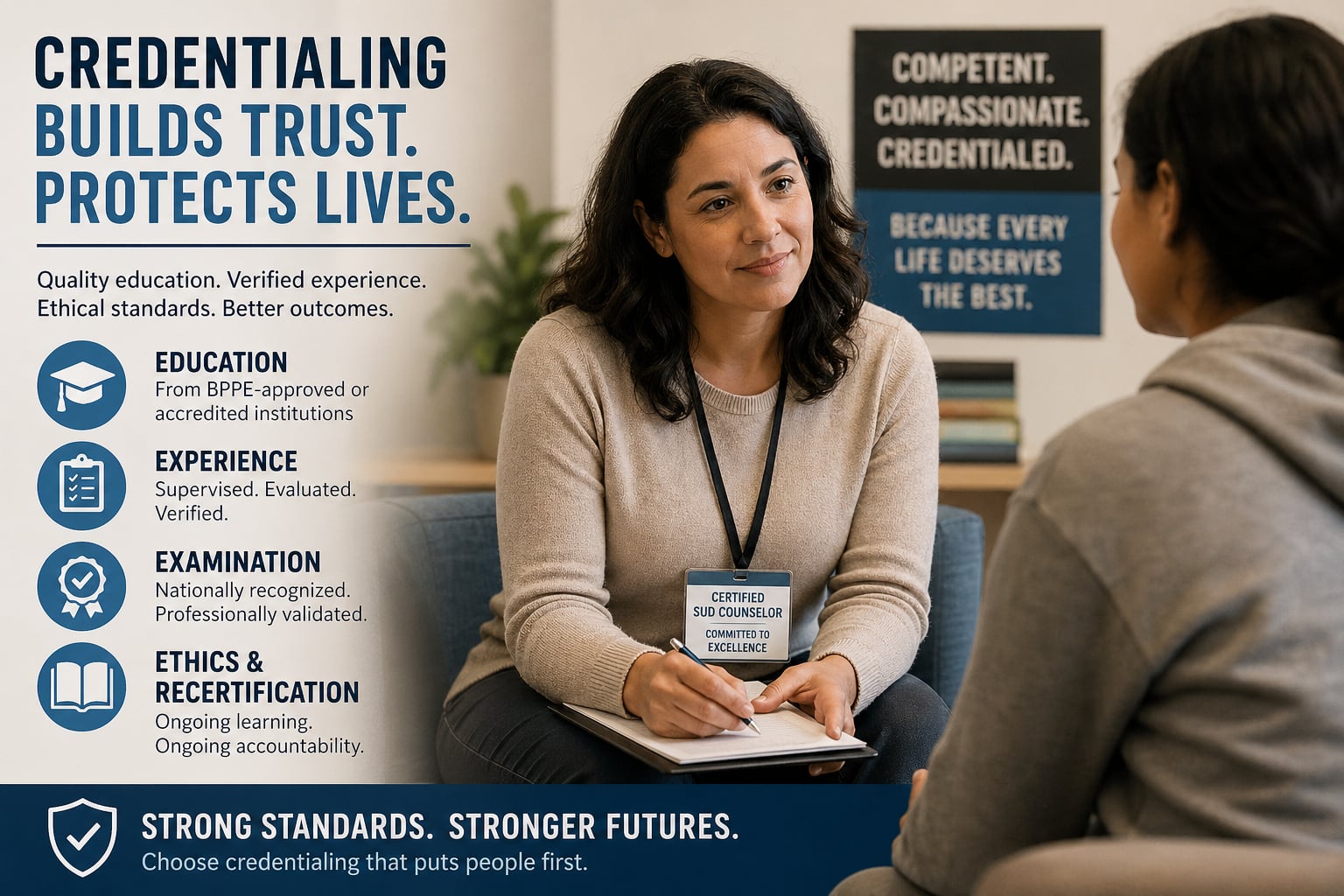
In the midst of a nationwide behavioral health crisis, the demand for substance use disorder (SUD) counselors has never been higher. Families are searching for help. Communities are investing in treatment. And individuals in recovery are placing their trust—and often their lives—in the hands of professionals who guide them through one of the most vulnerable periods they will ever face.
But here's the uncomfortable question we don't ask enough: Who is ensuring that these counselors are truly qualified?
Credentialing is not a bureaucratic hurdle. It is the backbone of public protection.
A National Standard Matters
At the heart of quality credentialing is the use of a nationally recognized examination, such as those developed by the International Certification & Reciprocity Consortium (IC&RC). These exams are not arbitrary—they are built on validated competencies, rigorous psychometric standards, and ongoing research into what effective counseling actually requires.
A nationally recognized exam does something critical: It ensures that a counselor in California meets the same core competency standards as one in New York, Texas, or abroad.
Without this level of standardization, we risk creating a fragmented system where qualifications vary wildly—and where consumers cannot reliably assess the competence of the person sitting across from them.
"Without standardization, we risk creating a fragmented system where qualifications vary wildly—and where consumers cannot reliably assess the competence of the person sitting across from them."
Education: Not All Pathways Are Equal
Equally important is where and how counselors receive their education. High-quality credentialing bodies require that education come from:
- Private postsecondary institutions approved by the Bureau for Private Postsecondary Education (BPPE), or
- Regionally or nationally accredited colleges and universities
This matters because these institutions are held accountable to strict educational standards. They must demonstrate curriculum integrity, qualified faculty, and measurable student outcomes.
In contrast, programs that bypass these safeguards may offer speed and affordability—but at what cost? When education is reduced to a checkbox rather than a foundation, the profession suffers. More importantly, the people receiving care suffer.
Experience Must Be Verified—Not Assumed
Counseling is not learned in theory alone. It is developed through supervised, real-world experience. Reputable credentialing organizations require:
- Supervised clinical hours under qualified professionals
- Formal evaluations of competency by those supervisors
- Verification processes that go beyond simple HR documentation
Because a letter from a human resources department confirming employment is not the same as a clinical supervisor attesting to a counselor's ability to build therapeutic alliances, navigate ethical dilemmas, respond to crises, and apply evidence-based practices.
Competency cannot be assumed. It must be observed, evaluated, and validated.

The Danger of "Easier and Cheaper"
In recent years, some organizations have marketed certification pathways as "faster," "easier," and "more affordable." On the surface, that may sound appealing—especially to individuals eager to enter the workforce.
But in healthcare, easier is not better.
Would you trust a surgeon who chose the quickest certification available? Would you feel confident placing a loved one in the care of a professional who bypassed rigorous training? Substance use disorder counseling is no different. The stakes are just as high.
Organizations that prioritize convenience over competency risk undermining the very purpose of credentialing: protecting the public.
"In healthcare, easier is not better. Would you trust a surgeon who chose the quickest certification available? The stakes in substance use disorder counseling are just as high."
The Role of Ethical Credentialing Bodies
Strong credentialing organizations do more than issue certificates. They:
- Enforce ethical standards
- Require continuing education rooted in legitimate institutions
- Mandate ongoing recertification to ensure skills remain current
- Maintain disciplinary processes to address misconduct
Recertification, in particular, is critical. It should not be a passive or superficial process. It must ensure that counselors continue to grow professionally through structured, credible educational experiences—not just informal or unverified learning.
Consumer Protection Is the Bottom Line
At its core, credentialing is about trust.
When a family seeks help for a loved one struggling with addiction, they are not evaluating accreditation status or exam validity. They are trusting that the system has already done that for them.
That trust must be earned.
By requiring nationally recognized examinations, accredited education, verified supervised experience, and meaningful continuing education, we uphold the integrity of the profession—and, more importantly, we protect the people who depend on it.
A Final Question
If someone you love needed help—real help—would you want them working with a counselor who chose the fastest, cheapest path to certification? Or one who was trained, tested, supervised, and held to the highest standard?
The answer is obvious. And that is exactly why credentialing is indispensable.