

In our view, no better model exists for institutional self-study (ACGME, 2021) and organizational self-study (NACCHO, n.d.) for recovery-based chemical dependency and other compulsive disorder treatment programs than the Fourth Step of the Twelve Steps of Alcoholics Anonymous (AA): “Made a searching and fearless moral inventory of ourselves.” (Alcoholics Anonymous World Services, 2001). The language and conceptual basis of all the Steps, including the Fourth Step, are well known and integrated into the minds and psyches of staff members and clients/residents of recovery-oriented treatment programs. It is also the model used by The Little Hill Foundation in its semiannual meetings of the Foundation’s board of trustees.
In this article, we will:
- Present an overview of the concept and practice of institutional self-study or organizational self-study as they are customarily applied in such settings as academic institutions (Dartmouth College, 2021), health care programs (LCME, 2017), nonprofit social service agencies (Hurtado, Carter, & Kardia, 2012), and others
- Discuss examples of how these concepts and practices are performed in some typical settings
- Use the Little Hill Foundation’s self-study as the example to present and discuss specifics of the use of the Fourth Step
Recommendations will be offered for its use in other chemical dependency and/or compulsive behavioral disorder programs.
Overview of the Institutional/Organizational Self-Study (ISS/OSS) Process
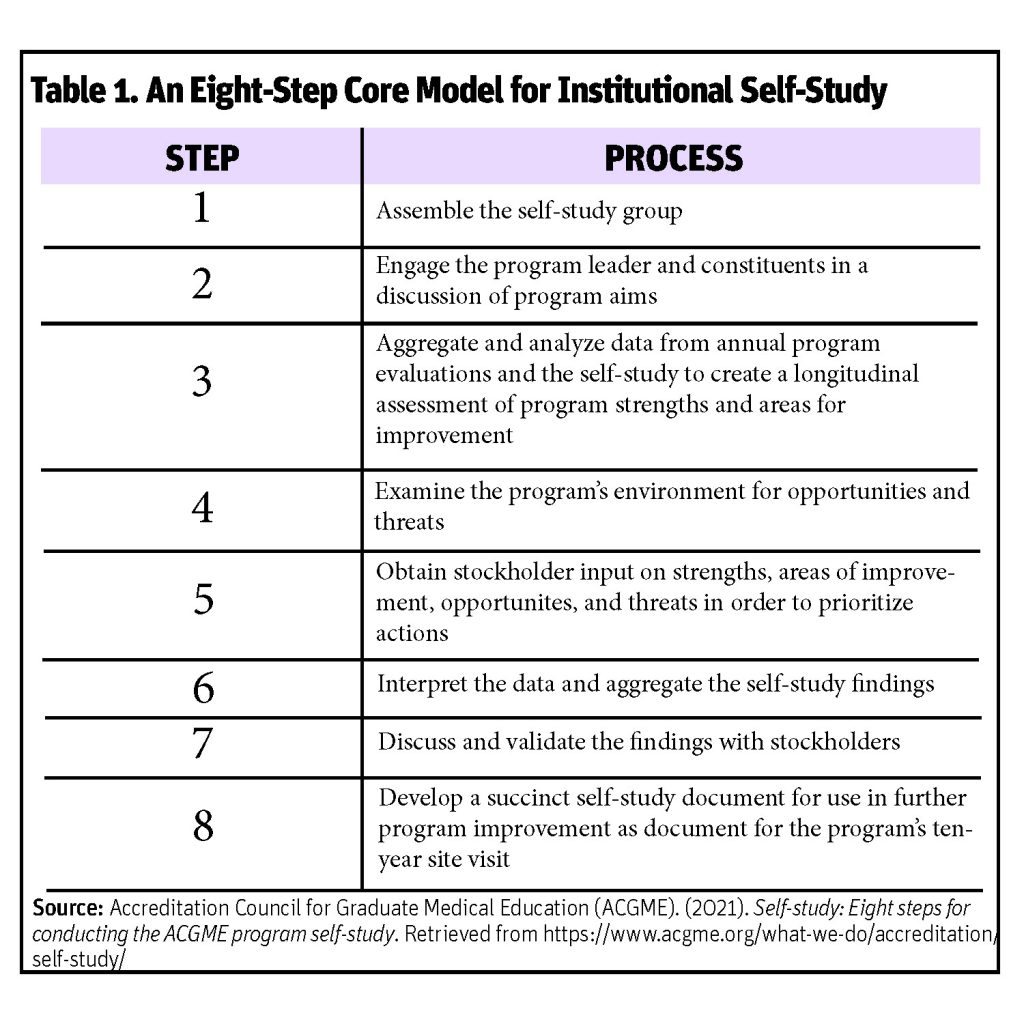
Table 1 illustrates eight basic steps in the self-study process for graduate medical education programs (i.e., residencies) in the United States and Canada. This distills the process into its component parts, as recommended for the member institutional residency programs subject to approval, or accreditation, by the Accreditation Council for Graduate Medical Education (ACGME). These eight steps serve as the core of the self-study growth process.
A variety of institutions, programs, organizations, governmental bodies, and businesses use the ISS/OSS model for self-assessment. This self-assessment informs individual organizational needs and improvements, and is required by external licensing, certification, and accrediting agencies such as the Joint Commission for the Accreditation of Health Care Organizations (JCAHO) and the Commission for the Accreditation of Rehabilitation Facilities (CARF).
Examples of the ISS/OSS Processes
Academia
Dartmouth College has engaged in a three-year—2018 to 2020—self-study process for its reaccreditation by the New England Commission of Higher Education (NECHE; Dartmouth College, 2021).
Government Health Agencies
The “Guide to Organizational Self-Study Process” by the National Association of County & City Health Organizations (NACCHO; n.d.) provides guidance to city and county health officials seeking accreditation by the Public Health Accreditation Board.
Health Care
The “Guide to the Institutional Self-Study” by the Liaison Committee on Medical Education (LCME) of the American Association of Medical Colleges (LCME, 2017) provides guidance for medical training organizations in institutional self-study.
Nonprofits
The organizational self-assessments webpage by the National Council of Nonprofits provides guidance for organizations seeking self-assessment for internal as well as external purposes (National Council of Nonprofits, 2021).
A cursory Google search will reveal many other such examples of ISS/OSS.
At The Little Hill Foundation
The Little Hill Foundation currently operates two separate service units:
- Alina Lodge, a recovery- and Twelve-Step-based, traditionally long-term and flexible (six- to twelve-month length of stay) residential, chemical, and behavioral dependency rehabilitation program
- Haley House, a sober house (i.e., step-down) facility for women, with variable length of stay (six months and more) in rural northwest New Jersey
Each component has a director for day-to-day operations and a voluntary board of trustees—many in personal recovery and many in recovery through a Little Hill Foundation component—of about fifteen members, responsible for strategic planning as well as overall supervision and monitoring of both units. The board’s strategic planning committee helps shape the vision necessary for long-term planning. As an example, the recommendation whether it is feasible to develop additional specialty programs (e.g., eating disorders) rests with that committee.
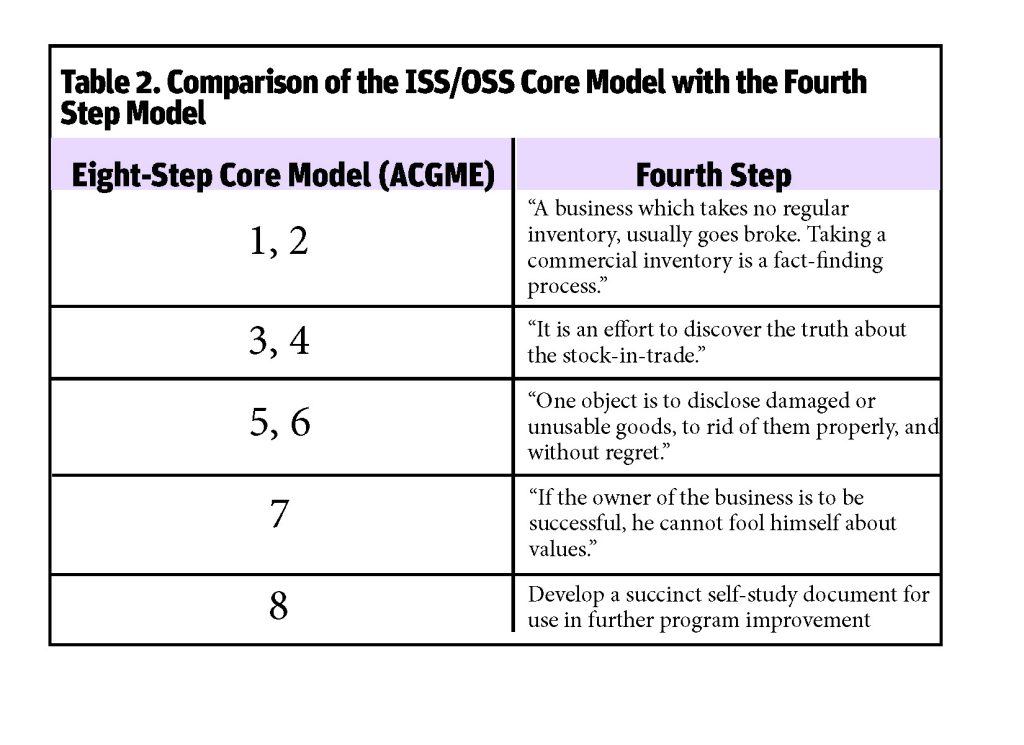
At a recent meeting of the board of trustees, the Fourth Step was conceptualized as the model, or basis, for the work of the strategic planning committee. A comparison of the aforementioned Eight-Step Core Model and the Fourth Step is illustrated in Table 2.
Conclusion
The Little Hill Foundation uses the Fourth Step of AA as a model, or structure, for strategic planning. In the past and going forward, the fruit of the studies provides the Foundation with the following:
- A useful and intuitive way of gathering data and using that data for program planning, analysis, and development
- A framework for a comprehensive review of clinical, financial, and administrative aspects of the program
- An approach that rings true for individuals in recovery who work at the program (e.g., counselors, nurses, physicians, administrators, and the like) in their endorsing the strategic planning of the program
Although the path will be difficult—looking at our own or our organizations’ deficiencies usually is—shadow boxing with the many hard decisions is the path to organizational growth and success when accomplished with foresight, honesty, humility, and compassion.
In summary, using the Fourth Step model as a framework, or guide, for strategic planning in recovery-oriented, Twelve Step treatment programs has been very helpful for The Little Hill Foundation. We recommend it for the consideration of all those involved in strategic planning and development.
References
- Accreditation Council for Graduate Medical Education (ACGME). (2021). Self-study: Eight steps for conducting the ACGME program self-study. Retrieved from https://www.acgme.org/what-we-do/accreditation/self-study/
- Alcoholics Anonymous World Services. (2001). Alcoholics anonymous (4th ed.). New York, NY: Author.
- Dartmouth College. (2021). Self-study report. Retrieved from https://www.dartmouth.edu/reaccreditation/self_study/
- Hurtado, S., Carter, D. F., & Kardia, D. (2012). The climate for diversity: Key issues for institutional self-study. New Directions for Institutional Research, 1998(98), 53–63.
- Liaison Committee on Medical Education (LCME). (2017). Guide to the institutional self-study. Retrieved from https://www.upstate.edu/ume/pdf/lcme/guide_to_institutional_self_study.pdf
- National Association of County and City Health Officials (NACCHO). (n.d.). Guide to organizational self-study process. Retrieved from https://www.naccho.org/uploads/downloadable-resources/Programs/Public-Health-Infrastructure/Organizational-Self-Study-Guide.pdf
- National Council of Nonprofits. (2021). Success: Organizational self-assessments. Retrieved from https://www.councilofnonprofits.org/tools-resources/organizational-self-assessments